

Safeguarding Our Blue Horizon: The Mission of COBSEA and the Power of Global Education
The seas of East Asia are among the most biologically rich, diverse,
and economically vital marine environments on the planet.
From sprawling coral reef networks to dense, carbon-sequestering coastal wetlands,
these waters support millions of people and host an unparalleled array of marine life.
However, these delicate ecosystems are not invincible.
They face urgent pressures from unsustainable coastal development,
accelerating climate change impacts, and rampant plastic pollution.
Protecting this vital resource requires more than local efforts;
it demands coordinated, science-based action across international borders.
Enter the Coordinating Body on the Seas of East Asia (COBSEA).
Charting a Course for Healthy Oceans
Administered by the United Nations Environment Program (UNEP),
COBSEA is a powerful regional intergovernmental mechanism.
It brings together nine participating countries—including several ASEAN member states
such as Indonesia, Malaysia, the Philippines, Thailand, and Viet Nam,
as well as Cambodia, China, the Republic of Korea, and Singapore.
Their shared primary mandate is the sustainable development
and protection of the marine environment and coastal areas across the East Asian Seas.
COBSEA’s strategic actions are driven by three main pillars to ensure the health of our oceans:
- 1. Marine Pollution Control:
- A major focus of COBSEA is addressing the marine litter crisis.
- Through the Regional Action Plan on Marine Litter,
- the organization works to reduce plastic pollution from poor land-based waste management and sea-
- based maritime activities.
- By championing circular-economy models and improved waste-management strategies for island
- and coastal nations,
- they aim to prevent pollution at its source before it reaches the water.
- 2. Biodiversity and Ecosystem Management:
- COBSEA plays a pivotal role in conserving critical marine and coastal habitats.
- This includes promoting the mapping, spatial analysis,
- and protection of Ramsar wetlands, seagrass beds, and coral reefs.
- They ensure that these vital zones are managed effectively using the most up-to-date environmental
- data.
- 3. Climate Action and "Blue Carbon":
- Recognizing the immense carbon sequestration potential of coastal marine environments,
- COBSEA actively promotes Nature-based Solutions (NbS).
- They support regional assessments of carbon stocks in mangroves and seagrasses,
- helping governments align their climate adaptation policies to protect these vital "blue carbon" sinks,
- which actively pull carbon out of the atmosphere.
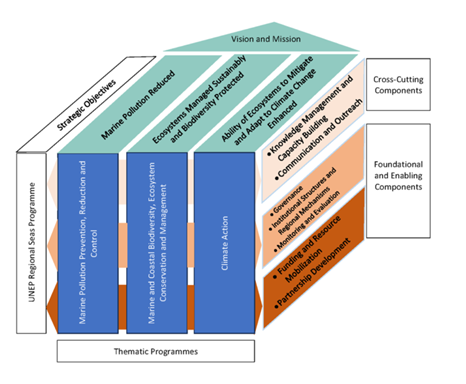
COBSEA thematic programs and cross-cutting, foundational, and enabling components
underpinning the Strategic Directions 2023-2027.
The Global Importance of COBSEA
The importance of COBSEA's mission cannot be overstated.
The East Asian Seas host the world's greatest concentration of coral reefs and mangrove forests.
Allowing these habitats to degrade
would not only devastate marine biodiversity but also destabilize the regional economy,
which relies heavily on fisheries, aquaculture, and coastal sustainable tourism.
Furthermore, COBSEA's work is a crucial line of defense in global climate regulation.
Mangrove and seagrass ecosystems in the ASEAN region efficiently trap greenhouse gases.
If these habitats are destroyed,
decomposing organic matter releases massive amounts of stored carbon
and methane back into the atmosphere,
accelerating global warming.
By fostering regional cooperation, COBSEA ensures standardized, scientific methods—
such as accurate calculations of a coastal area's Net Ecosystem Carbon Balance—
are used to monitor and preserve these natural defenses.
Additionally, marine plastic does not respect national boundaries.
A discarded plastic bag in one country can be carried by ocean currents to the shores of another.
COBSEA’s framework ensures neighboring countries aren’t fighting this battle alone.
Through shared data, collective monitoring, and unified policy guidelines,
they transform fragmented local efforts into a cohesive and effective regional strategy.
Building Possible Global Bridges
While COBSEA excels at shaping policy, guiding scientific monitoring,
and facilitating intergovernmental coordination,
achieving long-term sustainability requires a shift in public awareness and grassroots engagement.
Science and policy must be paired with education.
This presents a powerful opportunity for synergy between COBSEA,
the Global Environmental Education Partnership (GEEP),
and the North American Association for Environmental Education (NAAEE).
GEEP was co-initiated by the US Environmental Protection Agency (EPA),
Taiwan's Ministry of Environment, and NAAEE
to serve as an international learning network that champions environmental literacy.
With the GEEP Asia-Pacific Regional Center (APRC) headquartered in Taiwan,
there is a natural geographic and thematic overlap with COBSEA’s jurisdiction in East Asia.
Connecting these powerful entities could revolutionize
how marine science is translated into public action in several exciting ways:
- 1. Translating Hard Science into Engaging Curriculum:
- COBSEA generates high-level, complex data on marine litter tracking,
- spatial GIS mapping of wetlands, and blue carbon metrics.
- GEEP and NAAEE have the expertise to transform this dense scientific data into accessible,
- easy-to-understand educational toolkits for schools, universities, and community centers.
- By integrating real-world, regional data into classrooms,
- students can learn about complex topics
- —like the principles of a circular economy or coastal conservation—
- through the lens of their own local environments.
- 2. Empowering the Next Generation of Ocean Leaders:
- GEEP’s expansive platform for youth,
- including their "EE 30 Under 30" program and cross-border academic internships,
- perfectly aligns with COBSEA’s goals.
- An alliance could facilitate youth-led field research projects.
- Imagine university students leading community-based air and water quality monitoring,
- or designing sustainable tourism plans
- that directly support COBSEA's regional objectives
- while building essential local capacity.
- 3. Globalizing Local Success Stories:
- Through NAAEE’s massive international network of educators, researchers, and policymakers,
- successful coastal management practices from East Asia can be shared on a global stage.
- Whether it is an educational case study on Taiwan’s green night market management
- that reduces plastic waste, or an innovative nature-based solution
- from a Southeast Asian mangrove reserve,
- the NAAEE framework enables the rapid exchange of these best practices worldwide.
The Marine and Coastal Ecosystems (MCE) Framework, adopted in 2023,
guides COBSEA’s strategy on ecosystems and biodiversity conservation and management.
The Working Group on Marine and Coastal Ecosystems (WGMCE) was established
to implement the MCE Framework.
Anchored in the Blue Economy theme,
the MCE Framework provides clear direction for achieving targets
under the Sustainable Development Goals
and the Kunming-Montreal Global Biodiversity Framework.
- 1. Sustainable Blue Economy:
- Conserving the marine and coastal environment
- while ensuring inclusive and equitable sharing of resources
- and supporting the well-being and livelihoods of local communities.
- 2. Marine and Coastal Spatial Planning:
- Identifying and planning the use of marine and coastal space for conservation,
- fisheries, tourism, and other marine industrial activities.
- 3. Marine Protected Areas
- (MPAs, including MPA Networks and Other-Effective Area-based Conservation Measures):
- Protecting marine and coastal areas by regulating human activities
- to restore ocean health.
- 4. Marine and Coastal Habitats Conservation and Restoration
- (coral reefs, mangroves, seagrass, and coastal wetlands):
- Ensuring conservation of coastal ecosystems for their important services
- and value to nature during all related activities.
By merging the scientific rigor and regional authority of COBSEA
with the educational reach and innovative advocacy of GEEP and NAAEE,
we can build a comprehensive framework.
It is a partnership that will not only protect the oceans today
but will educate and empower the generations that will steward them tomorrow.